Every child is different and unique, but there are patterns we can master. When you ask something of your child and don’t take his temperament into account, there is a good chance it will fail.Think of all the energy you waste everyday, asking things, setting limits, calling for a hand, and getting no result. Isn’t it frustrating? Don’t you feel like you’re talking to a wall sometimes? Have you ever thought your child’s ignoring you on purpose? Well, it might actually be that you’re not tune to the right channel.
Temperaments To Get Listened To?
Defining personality traits isn’t to be taken lightly. There is an easy slip from identifying a temperament to put a label, and it’s one you don’t want to take. What defines us, our particularities, aren’t something we chose. Hence, we should never be judged for them.
[Tweet “Loving a child #unconditionally is the most precious gift you can offer”]
The understanding you gain on your child should always be used in a positive way. It is not about telling him that he is this or that. This article helps you understand your child so that you can have the necessary knowledge you need, in your mind and in your heart, to get your message through more efficiently.
Now that this is clear, let’s see what kind of temperaments exist. Some American scientists looked into it in the late 70s and I’m going to tell you what they assessed as their study is still widely used nowadays.
You don’t have time right now? Download the PDF of this blog post and read it later!
Easy
I guess that the name says it all… those kids are usually in a positive mood, don’t fear new situations, sleep well, eat well,… They are called easy because they are easy to raise and live by (that’s 40% of the studied children).
Difficult
Again, all is in the name… those kids have intense reactions, have difficulties with sleep and body functions, they are usually in a negative mood and they react strongly to frustration (10% of the studied children).
Slow-to-warm-up
Those kids need more time to learn and adapt. Their mood is more on the negative side but they have low intensity emotions. They don’t react well to new situations or people (15% of the studied children).
And how did they come up with those types?
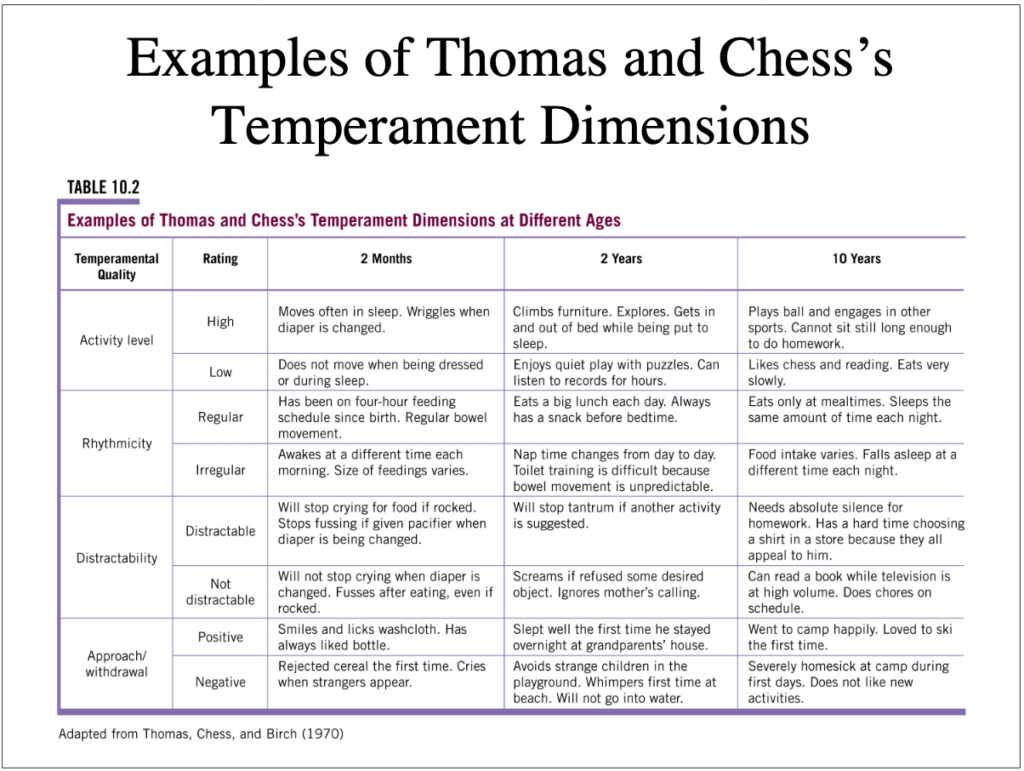
They actually observed a number of children over years and came up with 9 temperaments traits:
Activity Levels
Biological Regularity
Adaptability, Approach/Withdrawal
Sensitivity Threshold
Intensity of Emotional Response
Distractibility
Quality of Mood
Persistence/Attention Span
Source psych.colorado.edu
How Is This A Technique To Being Listened To?
Though it is interesting to see that they could figure out 3 temperaments types, it doesn’t really help with getting listen to, does it?
What it does is helping us understand and accept that they ARE different types of temperaments and therefore, that we can use those as a tool.
Let’s take a harder look at those three types as you see them all over the internet in parenting blogs, child’s development articles and so on.
First, when you read the study you’ll learn that 65% of the kids studied did fit in one of the categories. The other 35% are considered to be a bit of this and a bit of that. It might be that some kids have stronger traits than others (you might have one of your child popping to your mind right now) and it might be that, as they grow up, children’s traits evolve.
Children aren’t as « fixed » as adults, and this is why labeling them can be so devastating, as you deny them the chance to change.
I also think that there is more to say about each temperament than what they describe.
For the easy ones
So those are the easy to raise kids, great. But it is also means that it is sometimes hard to tell if they are going through a rough time or strong emotions. For example, those children might have issues learning to express their needs if they have strong willed parents. So let’s not forget to give those children attention!
For the difficult ones
At least with those ones you know where you stand! Thomas and Chess said that most of those kids developed behaviour issues, I say this is not a fatality, there is an educational path for those kids too.
For the slow-to-warm-up ones
Now, talk about labels. Those kids are often referred to as shy. They are not slow, they are more sensitive than other children. Sensitivity can be a great gift, if you’re taught how to deal with it.
The challenges are numerous:
Having a child with a “difficult” temperament (I really don’t like this word)
Having a child with a very different temperament than us
Having more than one child and them having different temperaments
My first two were of quite the easy kind. So imagine my surprise when I met number three and got a full difficult one:
High activity level
which is a nice way to say that he climbs everywhere and cannot sit still
Irregular rythmicity
he doesn’t fall asleep at the same times or eat the same amounts of food from one day to another
Not distractable
screams when frustrated, ignores the parents
Short attention span
gives up, ask for help, gets up from homework
And the thing is, you don’t know what’s happening! You ask yourself a lot of questions, you wonder what you did differently to get such a result? You try consequences, corner time, no tv, no tablet, and nothing works.
At this point parents usually starts to think that they failed somehow.
Source Austin Pacheco on Unsplash
A Reliable Technique Is All It Takes
Let me make you feel better: you didn’t fail. You child was born this way and that’s it. But, with the right tools you can make it better, you can even make it fantastic! And as much as the techniques you will learn here can improve your daily life and your relations with your children, remember the importance of mindset. The way you choose to look at your child has a huge impact on the outcomes.
[Tweet “Like a coin has heads&tails, a child’s #flaw has a fellow #quality”]
And you know what makes you the best parent ever?
You keep trying. If you read this, no matter the temperament of your child, it means that you are willing to understand your child better in order to be a better mom or dad.
As I said already, it is interesting to see that there are indeed different temperaments, though as parents you had the intuition of it I’m sure. And you know why it is important to know that?
Because there is a key for every lock. This is where a typological classification of people comes in handy.
As I said earlier, this article is created to help you communicate with your child, not to help you stick a label on him. Just to be clear, again. Understanding your child’s specificities cannot be used to manipulate him, but has to be used to create more peace and harmony in your life. Thanks for reading this, ethics are important to me.
Back to our keys: I find that the NLP model of meta-programs is much more rich and interesting when it comes to understanding your child than the 3 temperaments model.
You may have noticed, that the people you know have some kind of behavior patterns:
Maybe your mother is always positive?
Your husband is often bringing up memories?
Your best friend is always into projects but not so much into action?
When you’re asked something, you have a tendency to always answer « yes » first and think after or to say « no » first even if it might become a yes later, after reflection?
It is easier to see it in adults as we are more settled, but children have patterns too and it’s damn interesting to know about them!
Since children are more shifting, we need to observe them more carefully. Which is good, because learning to observe your child makes you a great parent!
The Meta-Programs As A Technique To Get Listened To
I want to share with you the meta-program model designed by Chritiane Grau, a Swiss NLP expert. She is brilliant and you’re going to love it!
First, let’s be clear on what’s a pattern: patterns are filters through which we perceive, analyze and take action. It’s our way to organize reality.
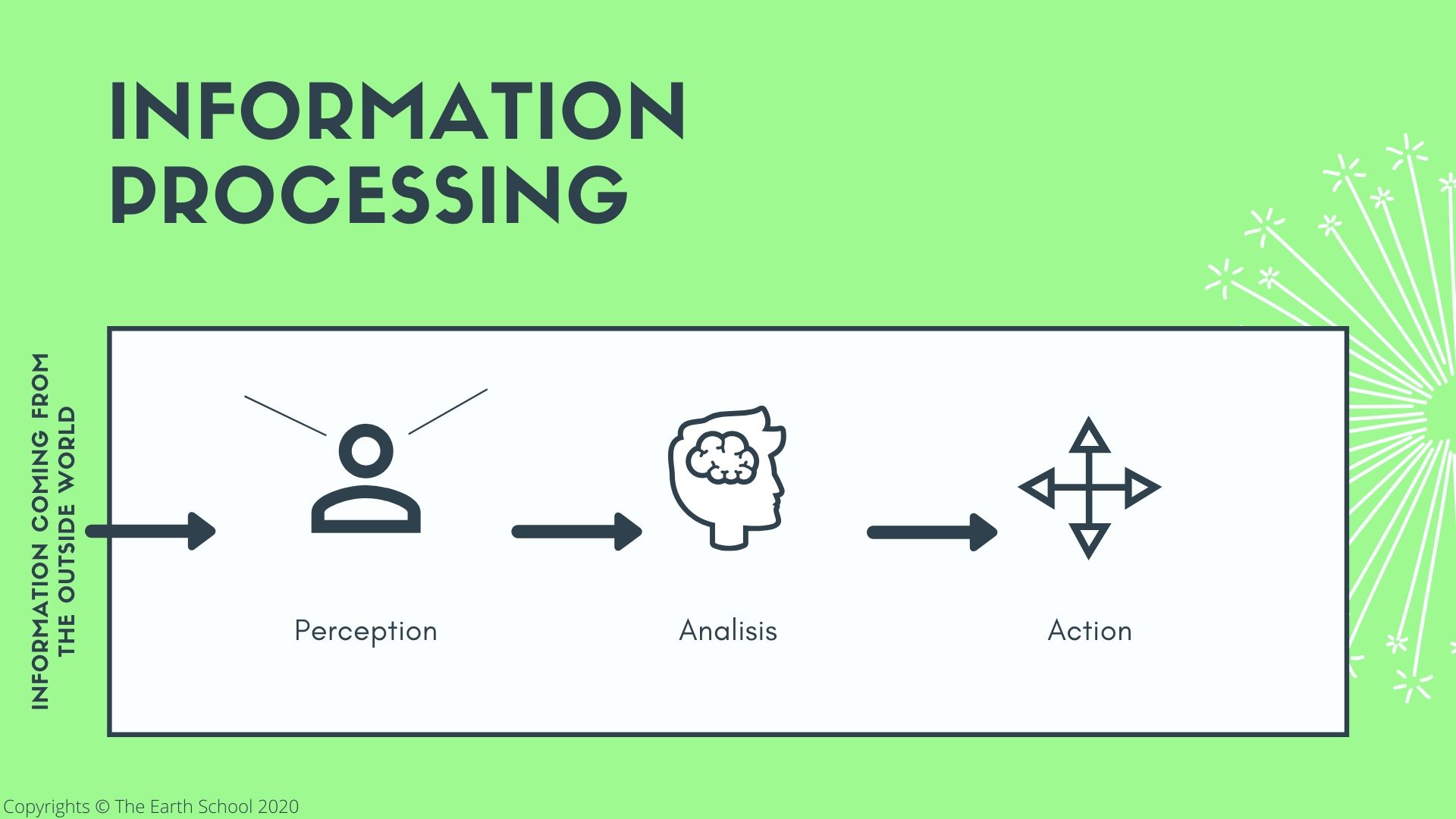
In the picture below, we can see that there is an information coming from the outside world, we perceive it, then we analyze it and eventually, we decide how to act upon it.
Have you noticed that not everyone feels like you or think and act like you?
That’s because we all have different patterns. And when a bunch of those patterns keeps kicking into action, we call it a meta-program. Those are kind of the “instructions for use” of yourself.
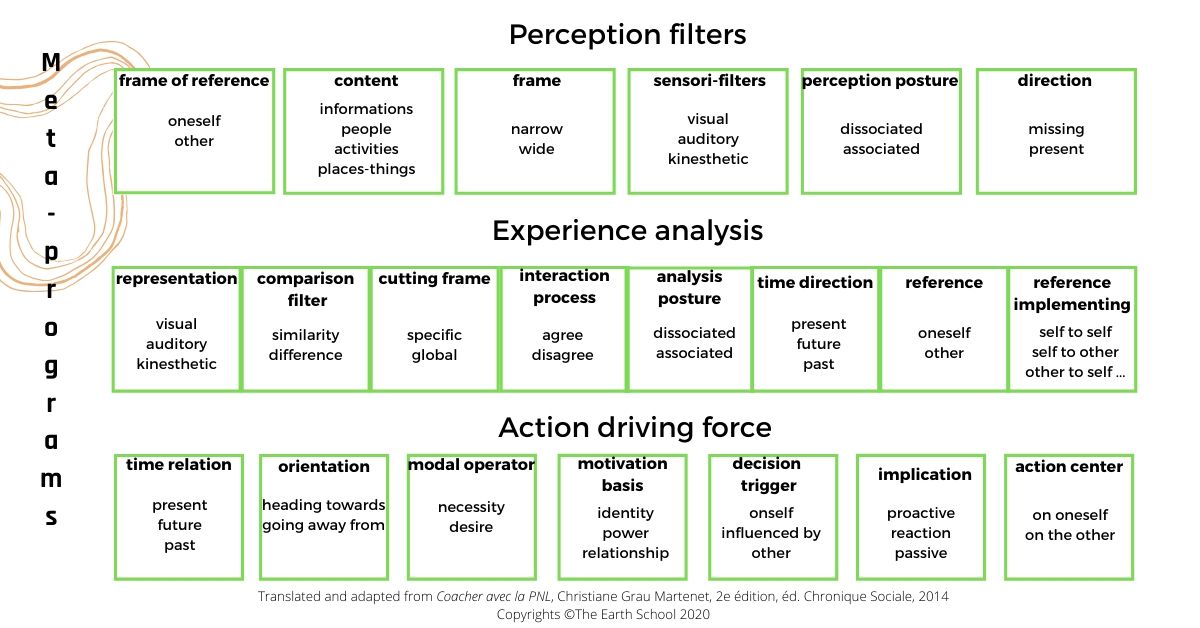
There are three categories of meta-programs depending on when they come into action:
Perception
When reality comes to you, you have a way to perceive it, for example, do you see the glass half full (you sort by what’s there) or half empty (you sort by what’s missing). They are 6 sorting filters.
Analysis
Once you’ve perceived, you have to analyze. Have you noticed how some people seem to always agree and some always to disagree? Yep, that’s here. They are 8 analyzing filters.
Action
Those are about your motivation, the “why would you do that”. Some people are more inclined to pursue a goal while some would rather distance themselves from something. They are 7 action filters.
It makes sense right? First you perceive something, then your brain analyses it and then you respond.
Now, if you observe your child carefully and can tell which patterns became meta-programs for him, you will know which button triggers what. (Don’t tell your husband about this article if you plan on using it on him, people tend to be offended when we tell them tat they are not so hard to decipher ha, ha).
Here is what the meta-programs look like:
I know it looks like a lot but don’t worry. First of all, only a handful apply to every individual and you will quickly recognize your child. And secondly, these are indications, helpers about understanding your child’s behavior, they are going to change with the time and it’s good to keep observing your child.
In my blog posts, I often suggest you to observe your child: always write your observations in the same notebook. It will save you the struggle to do the same observations over and over and in a couple of years you might find it very funny to read them again.
How To Turn The Meta-Programs Into A Reliable Technique
We saw earlier how they were 3 temperaments. But knowing that your child is easy, slow-to-warm or difficult won’t help you find practical solutions.
So let’s take a look at our meta-programs and see how they can help us.
One of the most powerful perception filter for you to look at is the sensory-filters meta-program. I will not go deep into it here as I did a whole video on the subject. Knowing what channel your child is tuned to is a huge helper in communication: if your child is auditory, there is no point leaving notes on the fridge, right?
Please watch the video if you haven’t already and learn tons of useful tips and actions you can implement straight away! And in the description you’ll find a link to our exclusive online test.to help you find out which sensory system your child uses most.
All right, let’s keep looking at the other perception filters, as there are some golden nuggets there too! The sensori-filters might be the most famous, but you will recognize the others as I tell you about them.
The frame of reference
When an information goes through the filter of the frame of reference,it can take 2 paths: oneself or other. Which means roughly: when I’m told something, do I perceive it according to myself only, or do I rather use other sources (people, movies, book, songs,…).
For young children, it’s always oneself, as they cannot take another point of view into consideration. Later, it might stay like this or they might develop an «influenced by others » frame of reference.
For example, you say: « let’s go now, we’re going to see grandma! ». The child will filter through his own standards (I don’t wanna stop playing, the road trip is long, I don’t like grandma’s cooking) or will be influenced by others (grandma will be happy to see me, we have to visit every Thursday, in my book the children are happy to go visit their grandma).
Can you imagine now how pointless it is to ask a child with a frame of reference «oneself » to take others feelings into consideration for example? If you tell him “grandma will be sad if we are late », it doesn’t affect HIM, so it has no impact.
Since you know that, you can stop wasting energy or being resentful toward your child when you feel he is being selfish.
The better we know each other, the more we love each other.
Henri Clausen
What Would Be A Reliable Technique In This Case?
If your child is very young, or if you observe that the Frame of reference “oneself” is a meta-program in your child (a recurring pattern), you might want to find ways to express your intention in a way that directly affects him. Let’s say your child is very strong minded and doesn’t want to go to grandma. You can drag him to the car and be ready for a terrible afternoon or you can ask some questions like:
“What is it you like best at grandma’s?”
“What’s your favorite thing to do in the car?”
“What toy would you choose for a long drive?”
“What about we prepare a little present for grandma and you can give her when we get there!”
Those questions will speak to your child and make him feel part of the project. He will perceive that the questions are about him and visiting grandma will become a second thought.
Children with a “oneself” perception system will be very sensible to the fact that they can make decisions. And this is gonna be great for you too as they will develop more autonomy in the process!
Source Edi Libedinsky on Unsplash
The content and frame aren’t very useful for our purpose so I’ll skip them. If you are dead curious about them or feel they might be useful to you, send me a message and I’ll give you more informations.
The Perception Posture
This one can create a lot of triggered reactions. For this perception filter, observe your children but yourself too!
If your child is associated, he will take the information with all his body, mind and heart. And that means with his emotions too. If you are a volcanic parent, good chances are your are associated in your perceptions.
Associated children perceive that way, but it doesn’t mean that they will analyze that way too. Why do I tell you that? Because, if your child doesn’t analyze in an associated posture, there is a good chance that, once the first outburst has passed, he will be out of his emotions in no time. So allow a time for the information to be processed and don’t associate with their association! Did you follow that?
For example
My daughter is definitely associated, and when she hears something, it’s filtered through her emotions first. The neighbour’s cat is dead? She associates with the neighbour and she is holding the poor dead cat in her arms and she is flooded with sadness. Well, she’s quite the extreme but some kids are, so don’t judge them or say dismissive comments, you will hurt them and make things worse. Accept their emotions.
Another example
If I am short-tempered and speak harshly or yell at my daughter, she will associate with my anger and throw it back to me. Since I am associate too, I take that new anger in the face and start yelling so loud it breaks my voice. Maybe now you get the « don’t associate with their association” better.
What Would Be A Reliable Technique In This Case?
If you observe that the perception posture “associated” is a meta-program in your child (a recurring pattern), you might want to find ways to express yourself in a way that won’t affect him.
Stay matter of fact and don’t go into drama.
Express facts rather than emotions. If the message is emotional (the cat is dead), speak about it in a way that doesn’t make your child dive deeper into his emotions.
Observe your child, if he’s already emotional, now is not a good time to add on.
Allow time for your child to process the information and come out of hie emotions.
Only an awareness of what’s going on, an mindful observation of yourself and of your children and some good sense to use all this information when you feel you’re getting associated can ease those situations. But what a relief when you manage!
Dissociated children (and parents)
They perceive the information from a neutral posture, they don’t engage their emotions. Which actually can get associated parents angry, as they don’t understand that one can be dissociated and think that their child doesn’t care. Well, he cares, just not as emotionally as you do.
The Direction Of The Perception
Another interesting one that can create tensions in a relation. This is quite an easy one to understand: some people see the glass half full and some see it half empty. With a good tendency for both sides to be annoyed by the other one…
Now is a good time to remind you that no one chooses his meta-programs, those are some sort of mental shortcuts and everyone develops its own. You CANNOT change someone’s meta-programs, but you can observe your children, acknowledge the meta-programs and accept them with unconditional love. And also you case use them as a tool when parenting 😉
As for the direction of perception, if you are « present » person, you see what’s here already. You will say in early Spring: “the sun is here today, and there is some grass in the garden, the leaves will come out soon ». If you are a « missing » person, you filter through what is missing and you will say: « it’s still not green, the garden is bare and there are no leaves in the trees. The sun is here but the warmth is missing yet ».
What Would Be A Reliable Technique In This Case?
Those who perceive what’s missing have to be extra careful with their children, as they might only express what’s missing and forget about what is here already.
Your child starts to write letters and one out of 10 is upside down? Bite your tongue before that’s the first thing you will say!
Your child perceive what’s missing?
you can have him practice to name a couple what there IS.
you can definitely encourage him to practice gratitude.
be mindful to let him be hard on himself when it comes to school or sport for example, as they will see what they lack rather than what they achieved already.
Children are not yet done growing and their meta-programs will change and evolve. You can teach them to see the beauty, the good and to be grateful for what they have rather than to complain about what they haven’t.
[Tweet “The best way to #teach something to our children is through #example”]
Try to say positive things during the day, about you, about them, about life, about others. Show gratitude for small things so that they see them with new eyes.
Source Derek Thomson on Unsplash
Perceptions Filters Are A Reliable Technique To Be Listened To
Upload our Action Sheet and start to use what you just learned!
What About The Other Filters: Analysis And Action?
Aren’t they part of the reliable technique?
Of course they are, and in amazing ways! Next week, I’ll explain all about the meta-programs used to analyze our experiences and how they influence our behavior.I will also tell you everything you need to know about the meta-programs that are action driving forces. This is where you will find out what influences the way your child ACT.
If You Take Action Today By Observing Your Child, In A Week You Will:
Have observed your child and his perception filters,
understand better his reactions to your messages and to the information he gets from the world,
know better how you can carve your messages so that they are perceived the intended way,
know yourself better too when it comes to perception filters,
have more empathy and patience for your child’s reaction,
have experiment ways to avoid the usual triggers, the traps where you fall everyday.
Upload the Action Sheet and get our custom support to implement the theory!
You don’t want to miss the part where you learn how to understand and manage your child’s actions?
You want to be sure you will get the knowledge you need to activate his motivation? Then you might want to subscribe to our newsletter and receive the next blog post straight to your email box!
Get access to our content upgrades and PDF blog posts right here!
Thanks for reading this article. As always, I hope it gave you some line of thoughts to explore as well as ideas to act and create a positive change in your life. Don’t let the inspiration fades and take action right away:
save the article in your favorites
decide on the one action you will implement today and write it in your notebook
share this article with 3 friends who could benefit from it
I wish you all the best with your kids, always remember that we all do the best we can at a given moment and don’t judge yourself harshly. Be confident and listen to your intuition. If what you do comes from a place of love, then you’re on the right path.
See you next week for our next article!
Don’t Forget To Join Our Community To Get Inspiration And Tips Straight in Your Mailbox
I wish you all the best with your kids. Always remember — we’re all doing the best we can in any given moment, so try not to judge yourself too harshly. Be confident and listen to your intuition. If what you do comes from a place of love, then you’re already on the right path.
If this post resonated with you — if you’ve ever walked ten paces behind your child, wondering if you’re ruining everything — come join us on Instagram.
It’s where I share reminders, reflections, and the odd parenting confession… for mums figuring it out one heart-twinge at a time.
If you want more resources, ⬇️ keep scrolling ⬇️
Looking for a way to set boundaries that feel fair for everyone? Here’s your home guide to healthy boundaries.
If your child is or is becoming a teenager, check out our parenting guide for teenagers!


 For the easy ones
So those are the easy to raise kids, great. But it is also means that it is sometimes hard to tell if they are going through a rough time or strong emotions. For example, those children might have issues learning to express their needs if they have strong willed parents. So let’s not forget to give those children attention!
For the difficult ones
At least with those ones you know where you stand! Thomas and Chess said that most of those kids developed behaviour issues, I say this is not a fatality, there is an educational path for those kids too.
For the slow-to-warm-up ones
Now, talk about labels. Those kids are often referred to as shy. They are not slow, they are more sensitive than other children. Sensitivity can be a great gift, if you’re taught how to deal with it.
For the easy ones
So those are the easy to raise kids, great. But it is also means that it is sometimes hard to tell if they are going through a rough time or strong emotions. For example, those children might have issues learning to express their needs if they have strong willed parents. So let’s not forget to give those children attention!
For the difficult ones
At least with those ones you know where you stand! Thomas and Chess said that most of those kids developed behaviour issues, I say this is not a fatality, there is an educational path for those kids too.
For the slow-to-warm-up ones
Now, talk about labels. Those kids are often referred to as shy. They are not slow, they are more sensitive than other children. Sensitivity can be a great gift, if you’re taught how to deal with it.

 Back to our keys: I find that the NLP model of meta-programs is much more rich and interesting when it comes to understanding your child than the 3 temperaments model.
You may have noticed, that the people you know have some kind of behavior patterns:
Back to our keys: I find that the NLP model of meta-programs is much more rich and interesting when it comes to understanding your child than the 3 temperaments model.
You may have noticed, that the people you know have some kind of behavior patterns:
 Have you noticed that not everyone feels like you or think and act like you?
That’s because we all have different patterns. And when a bunch of those patterns keeps kicking into action, we call it a meta-program. Those are kind of the “instructions for use” of yourself.
There are three categories of meta-programs depending on when they come into action:
Have you noticed that not everyone feels like you or think and act like you?
That’s because we all have different patterns. And when a bunch of those patterns keeps kicking into action, we call it a meta-program. Those are kind of the “instructions for use” of yourself.
There are three categories of meta-programs depending on when they come into action:
 I know it looks like a lot but don’t worry. First of all, only a handful apply to every individual and you will quickly recognize your child. And secondly, these are indications, helpers about understanding your child’s behavior, they are going to change with the time and it’s good to keep observing your child.
In my blog posts, I often suggest you to observe your child: always write your observations in the same notebook. It will save you the struggle to do the same observations over and over and in a couple of years you might find it very funny to read them again.
I know it looks like a lot but don’t worry. First of all, only a handful apply to every individual and you will quickly recognize your child. And secondly, these are indications, helpers about understanding your child’s behavior, they are going to change with the time and it’s good to keep observing your child.
In my blog posts, I often suggest you to observe your child: always write your observations in the same notebook. It will save you the struggle to do the same observations over and over and in a couple of years you might find it very funny to read them again.
 When an information goes through the filter of the frame of reference,it can take 2 paths: oneself or other. Which means roughly: when I’m told something, do I perceive it according to myself only, or do I rather use other sources (people, movies, book, songs,…).
For young children, it’s always oneself, as they cannot take another point of view into consideration. Later, it might stay like this or they might develop an «influenced by others » frame of reference.
For example, you say: « let’s go now, we’re going to see grandma! ». The child will filter through his own standards (I don’t wanna stop playing, the road trip is long, I don’t like grandma’s cooking) or will be influenced by others (grandma will be happy to see me, we have to visit every Thursday, in my book the children are happy to go visit their grandma).
Can you imagine now how pointless it is to ask a child with a frame of reference «oneself » to take others feelings into consideration for example? If you tell him “grandma will be sad if we are late », it doesn’t affect HIM, so it has no impact.
Since you know that, you can stop wasting energy or being resentful toward your child when you feel he is being selfish.
When an information goes through the filter of the frame of reference,it can take 2 paths: oneself or other. Which means roughly: when I’m told something, do I perceive it according to myself only, or do I rather use other sources (people, movies, book, songs,…).
For young children, it’s always oneself, as they cannot take another point of view into consideration. Later, it might stay like this or they might develop an «influenced by others » frame of reference.
For example, you say: « let’s go now, we’re going to see grandma! ». The child will filter through his own standards (I don’t wanna stop playing, the road trip is long, I don’t like grandma’s cooking) or will be influenced by others (grandma will be happy to see me, we have to visit every Thursday, in my book the children are happy to go visit their grandma).
Can you imagine now how pointless it is to ask a child with a frame of reference «oneself » to take others feelings into consideration for example? If you tell him “grandma will be sad if we are late », it doesn’t affect HIM, so it has no impact.
Since you know that, you can stop wasting energy or being resentful toward your child when you feel he is being selfish.

 Thanks for reading this article. As always, I hope it gave you some line of thoughts to explore as well as ideas to act and create a positive change in your life. Don’t let the inspiration fades and take action right away:







 Source psych.colorado.edu